The nervous system is the body’s most complex communication network. It controls everything from reflexes and muscle movement to emotions and memory. Understanding the structural components of the nervous system helps medical students and health professionals understand how electrical signals are transmitted throughout the body, maintaining coordination and function.
What makes nerve cells unique?
Unlike other cells in the body, nerve cells (neurons) are highly specialized for the transmission of impulses. They have a unique structure and perform complex communication functions that no other type of cell can perform.
Here are some key features that make nerve cells unique:
- Lack of centrosome: Neurons do not have a centrosome, which means they cannot divide or reproduce if damaged.
- Cytoplasmic extensions: Their cytoplasm contains nerve fibers (axons and dendrites) for impulse transmission.
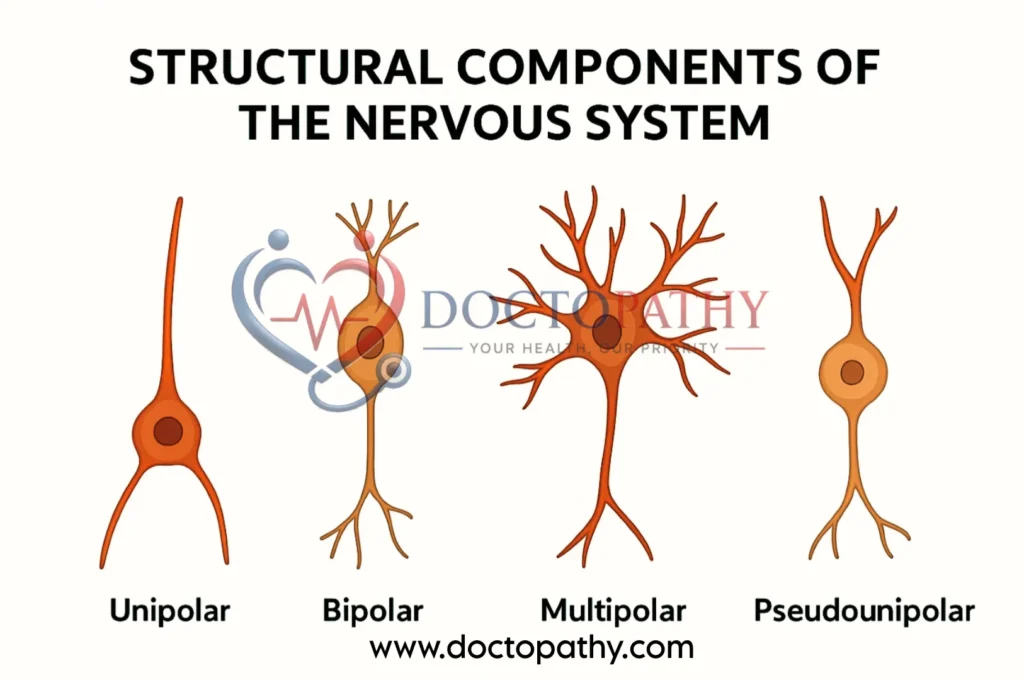
- Different types of forms: Neurons are classified into unipolar, confusing, multipolar and pseudounipolar types based on their structure.
- Variation in size and shape: There is great variation in their size, shape and arrangement of processes .
- Sensory neurons: confusing and pseudounipolar cells function as receptor neurons, which receive stimuli from sensory organs.
- Motor and interneuron cells: These are multipolar in nature and are responsible for sending signals to muscles and glands.
- Monopolar cells: True monopolar neurons are seen only in lower vertebrates and in the embryonic stage .
- Lack of neurilemma in the central nervous system (CNS): The fibers of the central nervous system (CNS) lack neurilemma, which hinders their regeneration after injury – this is one reason why spinal cord damage is often permanent.
Types of neurons and their functions
1. Receptor (sensory) neurons
- It is found in the retina, auditory system and sensory ganglia of the cranial nerves .
- They are usually confusing or pseudo unipolar in structure.
- There are two processes:
- Peripheral process: Carries impulses from sensory receptors to the central nervous system.
- Central process: It connects to the spinal cord or brain and forms synapses with interneurons.
- These neurons form afferent pathways, which transmit sensory information such as touch, sound and light.
2. Motor neurons
- Multipolar neurons located in the cranial and spinal nerve nuclei.
- Their cell bodies and dendrites form synapses with sensory and interneurons.
- Axons exit the central nervous system through motor roots to stimulate muscles or glands.
- This pathway is called the final common motor pathway, because all motor impulses pass through it before reaching the target organ.
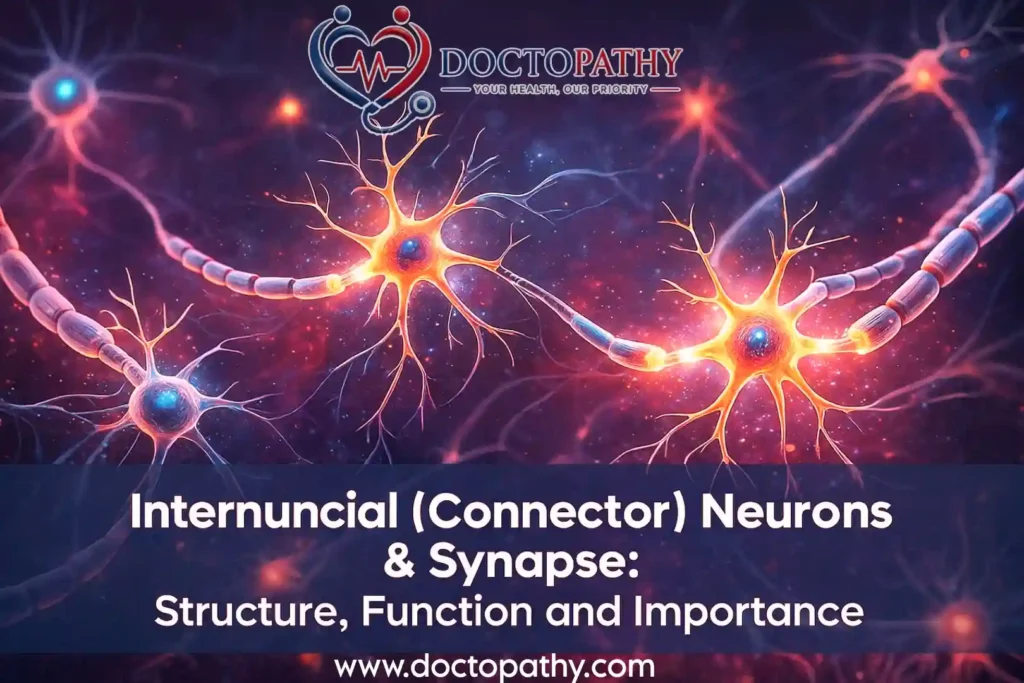
3. Interneurons (correlative neurons)
- Found within the brain and spinal cord .
- These act as connectors between sensory and motor neurons, ensuring efficient information processing and reflex control.
Nerve fibers and synaptic connections
Nerve fibers are long structures (axons) that carry signals between neurons. They can be of the following types:
- Myelinated fibers: These are covered with a layer of myelin, which increases the speed of transmission.
- Unmyelinated fibers: These have slow conduction speed, but are important in areas where rapid response is not required.
In the central nervous system (CNS), myelinated fibers lack neurilemma, making them difficult to repair after damage. Neurons communicate through synapses, where electrical or chemical signals are transferred from one neuron to another, ensuring uninterrupted communication throughout the nervous system.
Clinical Insights
Damage to nerve fibers in the central nervous system (CNS) — such as in spinal cord injury or stroke— is often irreversible due to the absence of the neurilemma. In contrast, peripheral nerves can sometimes regenerate if the neurilemma sheath remains intact, allowing partial recovery of function.
Conclusion
The structural components of the nervous system form the foundation of human neurophysiology. From the specific shape of neurons to the complex network of synapses, each element plays a vital role in maintaining communication between the brain, spinal cord and the rest of the body. Understanding this structure is essential for the effective diagnosis and treatment of neurological disorders.
Synapses are important for the transmission of signals and the coordination of body functions.
Nerve cells are highly specialized and non-replicative .
Sensory neurons transmit information to the central nervous system (CNS), while motor neurons send commands from the CNS to effector organs.
The central nervous system (CNS) lacks a neurilemma, limiting its ability to regenerate after injury.
The main structural components of the nervous system include neurons (nerve cells), nerve fibers, synapses and supporting cells (neuroglia). Together, these elements transmit electrical impulses in the brain, spinal cord and peripheral nerves.
There are four main types of neurons based on their structure:
unipolar neurons, confusing neurons, multipolar neurons and pseudounipolar neurons.
Each type of neuron has a different function, such as sensory reception, motor control or interneuronal communication.
● Sensory neurons (afferent) carry impulses from sensory organs to the central nervous system (CNS) .
● Motor neurons (efferent) transmit commands from the central nervous system (CNS) to muscles or glands to produce movement or secretion.
Neurons in the central nervous system (CNS) lack the neurilemma sheath, which is essential for nerve regeneration. Without this protective sheath, damaged nerve fibers in the brain and spinal cord cannot regrow, leading to permanent loss of function in many cases.
The final common motor pathway refers to the route through which all motor impulses travel from the central nervous system (CNS) to the muscles. It consists of the axons of motor neurons, which connect directly to muscle fibers to produce movement.