The human nervous system is an extremely complex network of neurons that transmit impulses throughout the body. Among these neurons, internuclear neurons, also known as connector neurons or interneurons, play a crucial role in connecting sensory and motor pathways. They form the backbone of reflexes, neural communication, and higher-level brain functions. In this article, we explain the structure, functions, synapses, and importance of internuclear neurons in an easy and reader-friendly way.
What are interneuronal (connector) neurons ?
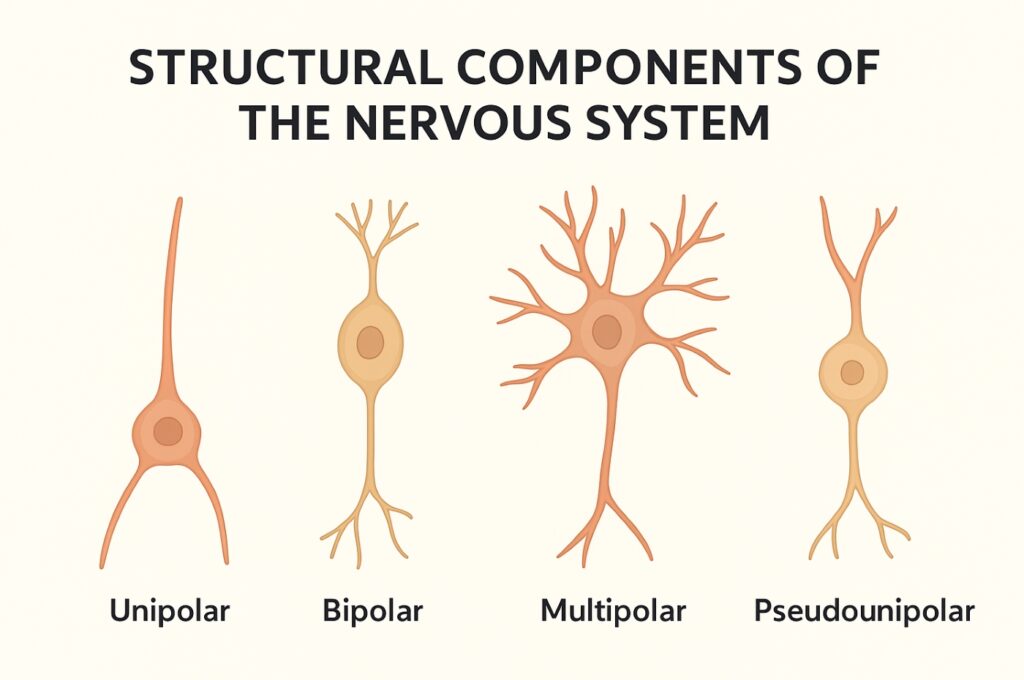
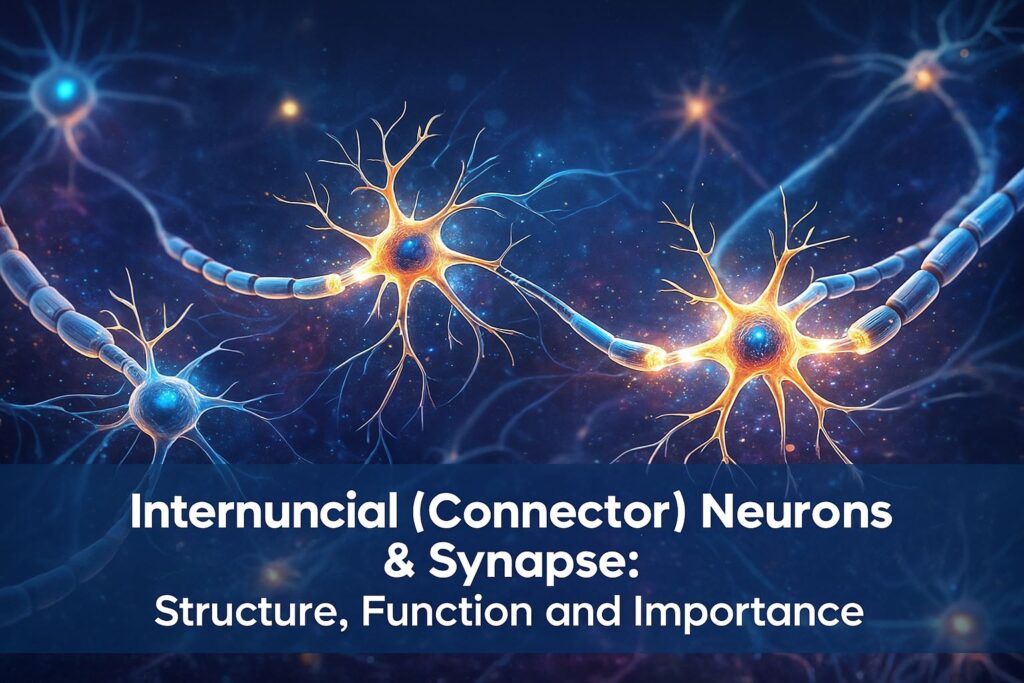
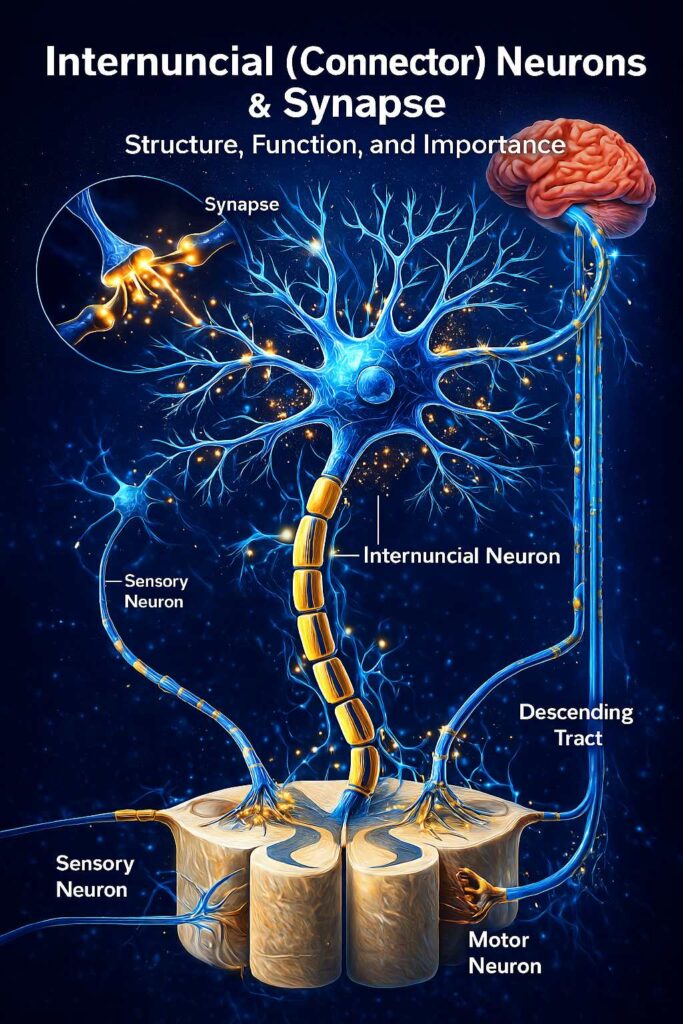
Interneural neurons are multipolar nerve cells found primarily in the central nervous system (CNS). They act as a bridge and transmit nerve impulses from sensory (receptor) neurons to motor neurons.
Also read this post :- Human Heart: Functions, Structure & How It Works
Main characteristics
- Their cell bodies and axons are located entirely within the central nervous system.
- They receive information from sensory neurons and transmit it to motor neurons.
- Some interneurons are also found in the autonomic nervous system .
- Their dendrites are short, highly branched, and spread irregularly around the cell body.
- Their axons can be up to 100 cm long and branch into fine terminal filaments.
- They have a myelin sheath , but no neurolemma, because they never exit the central nervous system.
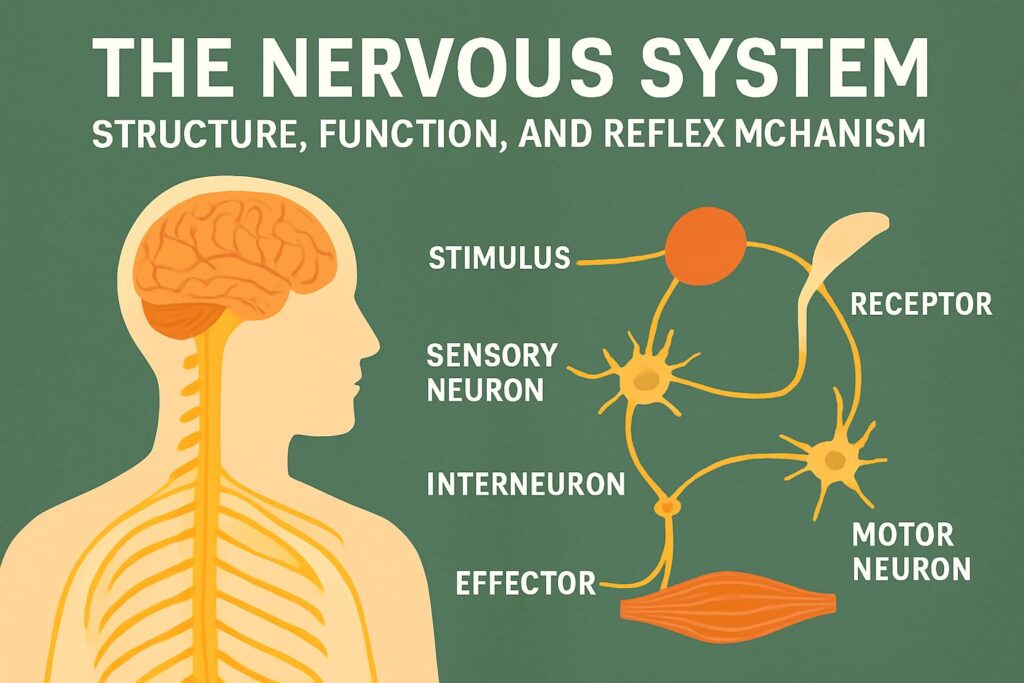
The role of interneurons in reflex arcs
Reflexes are quick, involuntary responses to stimuli. Several spinal reflex arcs include:
- An interneuron between sensory and motor neurons
- or many interneurons , forming complex neural circuits
Some interneurons also send impulses to higher brain centers, forming ascending and descending pathways in the brain and spinal cord.
Synapse: The point of contact between neurons
A synapse is a small junction where the terminal end of an axon communicates with the dendrite or cell body of another neuron.
The structure of synapses
- Axon terminals form knob-like structures called terminocks .
- These live in very close proximity , without structural continuity.
- Under a microscope, synapses can look like bulbs, rings, or loops.
Important Facts About Synaptic Transmission
- Nerve impulses travel in only one direction across the synapse – from the axon to the dendrite or cell body.
- This one-way flow is called dynamic polarity .
- Synapses exhibit a slight delay in impulse transmission .
- They tire more quickly than axons.
- They are highly sensitive to certain chemicals and drugs such as strychnine and nicotine .
Synapses in the spinal cord
The anterior gray matter column of the spinal cord contains motor neurons that form the final common motor pathway. Each of these motor cells may receive over a thousand synapses , allowing for complex coordination and integration of signals.
Two key features of interneural and motor neurons
- Rich synaptic connections – allows efficient communication and integration.
- Collateral branches of axons – enable impulses to spread along different pathways for coordinated responses.
These characteristics help the nervous system:
- integrate sensory (afferent) signals
- Coordinated motor (efferent) responses
- Build complex neural circuits
Neuron Doctrine: Independent Structure of Neurons
The neuron theory states:
- Each neuron is an independent structural and functional unit .
- There is no physical continuity between neurons ; only close contact occurs at synapses.
- Nerve impulses cross the synapse but the neurons remain separate.
Although once debated, the neuron theory is now universally accepted .
Also read this post :- Nervous system: structure, function and reflex mechanisms
Conclusion
Interneural neurons are essential components of the nervous system, ensuring smooth communication between sensory input and motor output. Their extensive synaptic networks and axonal branches make them crucial for reflex actions, coordination, and higher brain functions. Understanding interneural neurons and synapses helps us understand the complexity and efficiency of the human nervous system.
Also read this post :- Structural components of the nervous system: Understanding the functioning of neurons