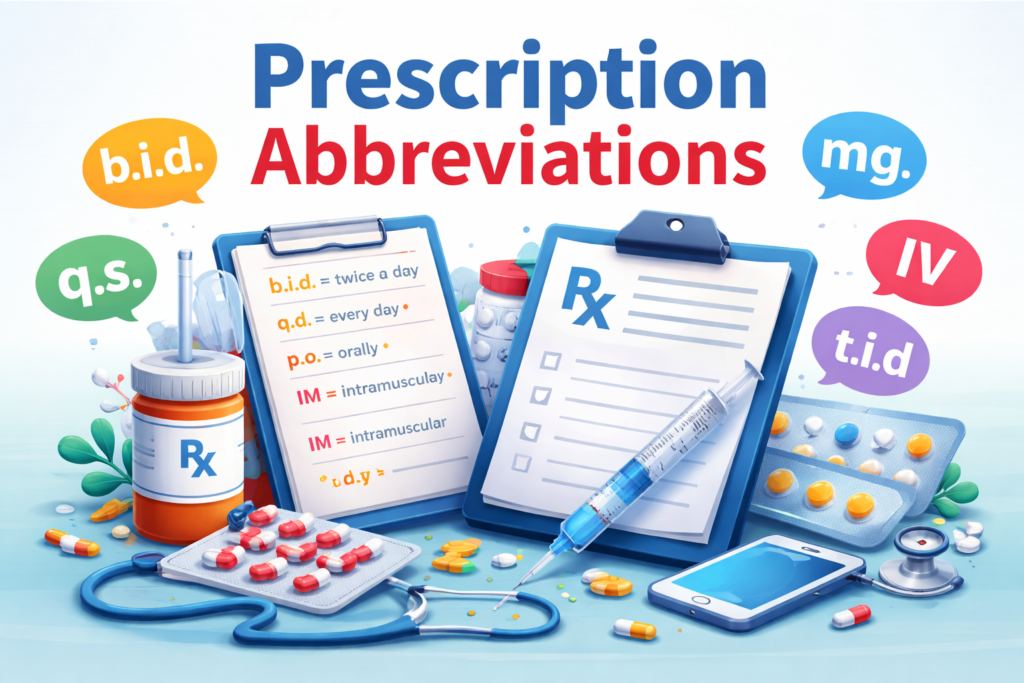
Weights and Measures Used in Prescriptions
These abbreviations are commonly used to describe the quantity, strength, or volume of medicines:
Also read this post :- Gout (Monosodium Urate Crystal Disorder): Causes, Symptoms, Treatment, and Prevention
- cc – cubic centimeter
- g / gm / GM – gram
- gal. – gallon
- gr. – grain
- gtt. (gutta/e) – drop(s)
- kg – kilogram
- L / l – liter
- lb. – pound
- m² – meter square
- mg – milligram
- µg / mcg – microgram
- mEq – milliequivalent
- ml – milliliter
- ng – nanogram
- oz. – ounce
- pg – picogram
- pt. – pint
- qt. – quart
- tbsp. / T – tablespoonful
- tsp. / t. – teaspoonful
- q.s. – quantity sufficient
- q.s. ad – quantity sufficient to make
Prescription Timing & Frequency Abbreviations
These abbreviations describe when and how often a medicine should be taken:
- a / ante – before
- a.c. (ante cibum) – before meals
- p / post – after
- p.c. (post cibum) – after meals
- a.m. – morning
- p.m. – afternoon / evening
- h (hora) – hourly
- hr – hour
- h.s. (hora somni) – at bedtime
- o.d. (omne in die) – once daily
- b.i.d. / b.d. (bis in die) – twice a day
- t.i.d. / t.d.s. (ter in die) – three times a day
- q.i.d. (quarter in die) – four times a day
- q (quaque) – every
- q.d. – every day
- q.h. – every hour
- q.h.s. – every bedtime
- p.r.n. (pro re nata) – when required
- s.o.s. (si opus sit) – as and when required
- stat (statim) – immediately
Routes of Administration Abbreviations
These indicate how the medicine should be given:
- PO / p.o. (per os) – by mouth (oral)
- IV – intravenous
- IM – intramuscular
- SC / s.q. – subcutaneous
- SL – sublingual
- PR / p.r. (per rectum) – rectally
- IT – intrathecal
- ET – endotracheal
- NG – nasogastric
Eye, Ear & Directional Abbreviations
- o.d. – right eye
- o.s. / o.l. – left eye
- o.u. – both eyes
- a.d. – right ear
- a.s. – left ear
- a.u. – both ears
Dosage Forms & Drug Release Abbreviations
- Tab – tablet
- Cap – capsule
- Syr – syrup
- Susp – suspension
- sol. – solution
- ung. – ointment
- tr. / tinct. – tincture
- mist. – mixture
- DT – dispersible tablet
- MD – mouth dissolving
- IR – immediate release
- SR – sustained release
- CR – controlled release
- ER / XR – extended release
- ES – extra strength
- XT – extra time
Also read this post :- Traumatic Rupture of Tympanic Membrane (Perforated Eardrum): Causes, Symptoms, and Treatment
Prescription & Clinical Abbreviations
- BP – blood pressure
- BMI – body mass index
- CBC – complete blood count
- CSF – cerebrospinal fluid
- C/I – contraindications
- SE – side effects
- indic – indications
- dx – diagnosis
- inf – infusion
- inj – injection
- IVP – intravenous push
- IVPB – intravenous piggyback
- IVIG – intravenous immunoglobulin
- PEM – protein energy malnutrition
Prescription Instructions & Dispensing Terms
- D / dose – dose
- disp. – dispense
- div – divided
- dil. – dilute
- Sig. – write on label
- R (Recipe) – take thou
- u.d. (ut dictum) – as directed
- non rep. – do not repeat
- NR – no refill
- D.C. / dc / disc. – discontinue
Conclusion
Prescription abbreviations play a vital role in medical practice, but misunderstanding them can lead to serious medication errors. Learning these commonly used abbreviations helps healthcare professionals, students, and patients ensure safe, accurate, and effective medication use.
For more medical guides, prescription explanations, and health education articles, keep visiting our website.
Also read this post :- Nervous system: structure, function and reflex mechanisms
Frequently Asked Questions (FAQs)
What are prescription abbreviations?
Prescription abbreviations are standardized short forms used by doctors, pharmacists, and healthcare professionals to write medical instructions quickly and efficiently. They include abbreviations for dosage, timing, routes of administration, and drug forms.
Why are prescription abbreviations important?
Prescription abbreviations help save time and ensure uniform communication among healthcare professionals. When understood correctly, they reduce confusion and support safe and accurate medication use.
Can prescription abbreviations be confusing for patients?
Yes, some abbreviations can be confusing for patients. That is why pharmacists often explain prescriptions clearly, and many healthcare systems now encourage writing full instructions to minimize medication errors.
What does “b.i.d.” mean on a prescription?
The abbreviation b.i.d. (bis in die) means that the medicine should be taken twice a day.
What is the difference between b.i.d., t.i.d., and q.i.d.?
b.i.d. – twice a day
t.i.d. – three times a day
q.i.d. – four times a day
What does “p.r.n.” mean in medical prescriptions?
p.r.n. (pro re nata) means the medicine should be taken only when required, such as for pain or fever
What does “stat” mean in a prescription?
Stat (statim) means the medicine should be given immediately, usually in emergency situations.
What does PO mean in medical terms?
PO (per os) means the medicine should be taken by mouth (orally).
Are prescription abbreviations the same worldwide?
Most prescription abbreviations are based on Latin and are commonly used worldwide, but some abbreviations and practices may vary slightly between countries and healthcare systems.
Should patients memorize prescription abbreviations?
Patients do not need to memorize abbreviations, but having basic knowledge helps them understand prescriptions better. Always ask a doctor or pharmacist if any instruction is unclear.