
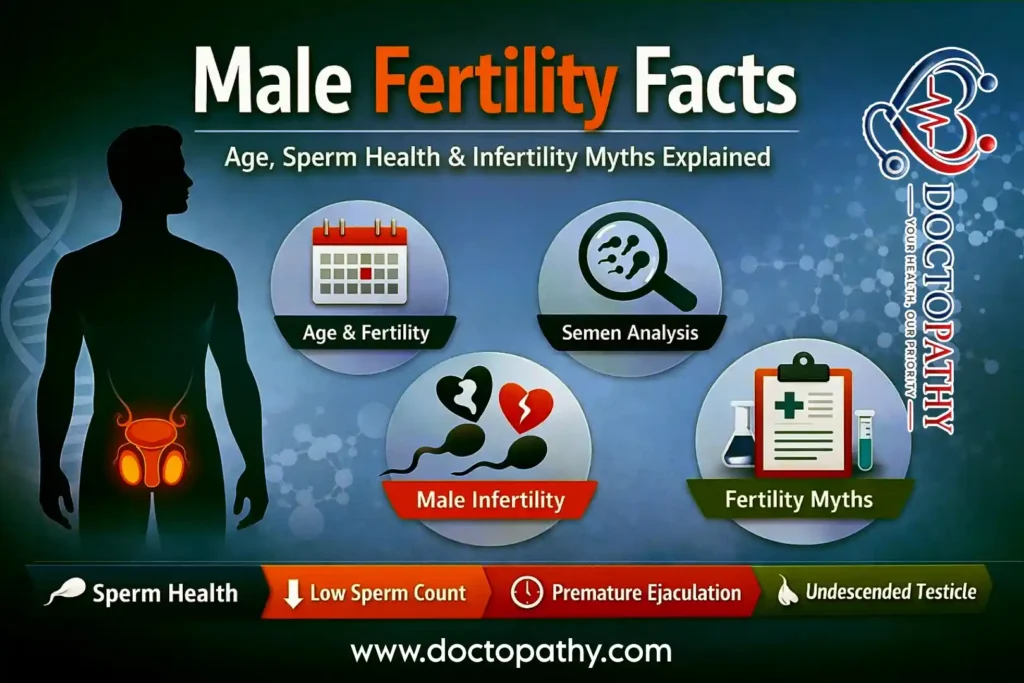
Male fertility is often misunderstood due to myths, outdated beliefs and lack of awareness. Many people assume fertility is only a female concern, but a man’s reproductive health plays an equally important role in conception. Below are important medical facts about male fertility, explained in simple language.
1. Is There an Age Limit for Male Fertility?
There is no fixed upper age limit for men to father children. Once puberty is reached, a male can theoretically produce sperm throughout life. However, sperm quality may decline with age, which can affect fertility and increase genetic risks.
Men can become fertile as early as 16–18 years, depending on the onset of puberty.
2. Can Boys Below Puberty Cause Pregnancy?
A boy below puberty (usually under 12–13 years) cannot cause pregnancy because his semen does not contain mature sperm. Although erections or sexual responses may occur, reproductive ability is absent until sperm production begins.
3. Does Semen Thickness or Quantity Affect Fertility?
The color, thickness, or volume of semen alone does not determine fertility. A man with thin or low-volume semen can still be fertile.
👉 The real factor is sperm health, which includes:
- Sperm count
- Sperm motility (movement)
- Sperm morphology (shape)
4. How Is Male Fertility Tested?
Male fertility is primarily tested through a semen analysis, not a “scanning instrument.” This laboratory test evaluates:
- Sperm count
- Motility
- Morphology
- Semen volume and pH
This is the most reliable way to assess reproductive capacity.
5. Does Excessive Sexual Activity Reduce Fertility?
Very frequent ejaculation in a short period may temporarily lower sperm count, but it does not cause permanent infertility.
The body continuously produces sperm, and normal sexual activity does not weaken fertility in healthy men.
6. Can Premature Ejaculation Cause Infertility?
Premature ejaculation does not directly cause infertility.
However, pregnancy may be less likely if semen is ejaculated outside the vagina before penetration.
When ejaculation occurs inside the vagina, fertility is usually unaffected.
7. Is Fertility Highest During Adolescence?
Male fertility is generally highest in late adolescence and early adulthood due to:
- Higher sperm quality
- Better motility
- Fewer genetic abnormalities
However, fertility can remain adequate well into later life.
8. Can Infertility Occur After Having Children?
Yes. Male infertility can develop at any age, even in men who already have children. Causes include:
- Infections
- Hormonal disorders
- Varicocele
- Lifestyle factors
- Chronic illness
This condition is known as secondary infertility.
9. Does Pus Discharge From the Urethra Affect Sperm?
Pus discharge usually indicates a genital or urinary tract infection.
While mild infections may not affect sperm, untreated or chronic infections can damage sperm quality and should be treated promptly.
10. Does Urethral Bleeding Affect Sperm Count?
Occasional urethral bleeding does not directly reduce sperm count, but it may signal an underlying condition that requires medical evaluation.
11. Can Fertility Return After Treating STDs?
Yes. Conditions like gonorrhea or other sexually transmitted infections, if treated early, often allow fertility to return.
Delayed treatment, however, can cause permanent reproductive damage.
12. Can Men With One Undescended Testicle Have Children?
Yes. Men with one functioning testicle can usually father children.
However, if both testicles remain undescended and untreated, infertility is more likely.
Early surgical correction (orchiopexy) improves fertility outcomes.
Conclusion
Male fertility depends mainly on sperm health, not myths about semen appearance, sexual strength or age alone. Many fertility problems are treatable if diagnosed early.
If pregnancy is delayed for more than 12 months of regular unprotected intercourse, a medical evaluation of both partners is recommended.
FAQs
There is no fixed upper age limit for male fertility. Men can produce sperm throughout life, but sperm quality and motility may decline with age, which can affect fertility.
The most common causes of male infertility include low sperm count, poor sperm motility, abnormal sperm shape, hormonal imbalance, infections and lifestyle factors such as smoking and stress.
No. Semen thickness or volume does not determine fertility. Fertility depends on sperm count, movement and structure, which are checked through semen analysis.
Yes. Many cases of male infertility are treatable through medication, lifestyle changes, treatment of infections, surgery or assisted reproductive techniques, depending on the cause.
Male fertility is primarily tested through a semen analysis, which measures sperm count, motility, morphology and overall semen quality.
Content Writer:- Dr. Parminder Singh (BEMS)