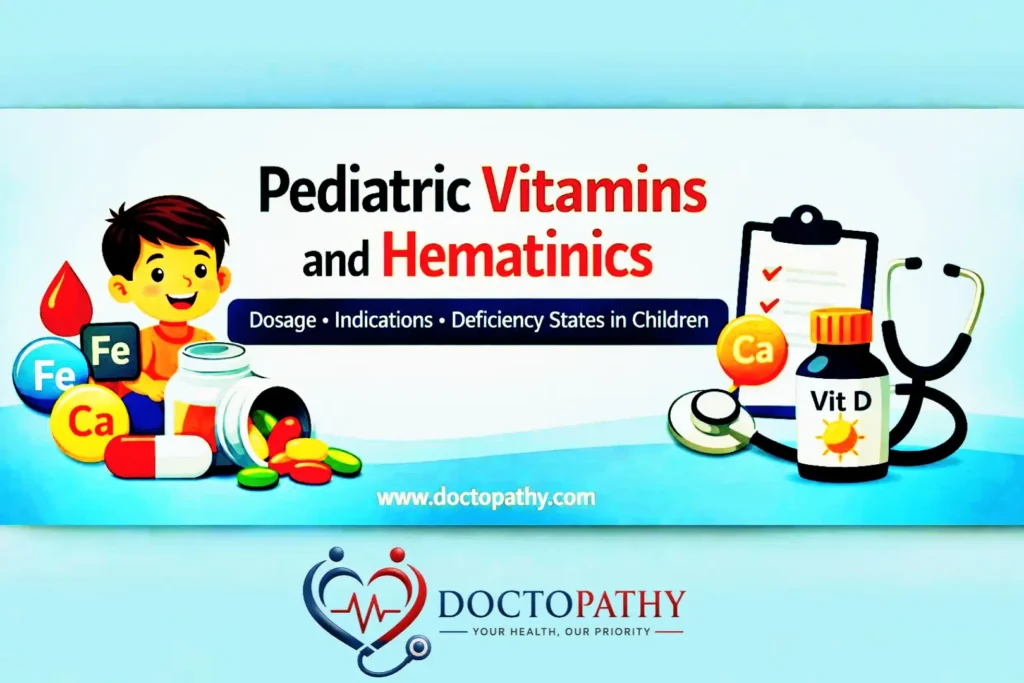
Vitamins and hematinics play a vital role in growth, development and disease prevention in children. Deficiencies during infancy and childhood can lead to serious health problems such as anemia, rickets, neurological disorders and impaired immunity. This article provides a comprehensive pediatric guide to commonly used vitamins and hematinics, including dosage, indications and precautions.
Alfacalcidol (Vitamin D Analog)
Alfacalcidol (1α-hydroxycholecalciferol) is a synthetic derivative of vitamin D₃. It is a prodrug that is rapidly converted in the liver to calcitriol, the active form of vitamin D.
Dosage
- Premature infants: 0.05–0.1 µg/kg/day
- Children <20 kg: 0.05 µg/kg/day
- Children >20 kg: 1 µg/day
- Renal osteodystrophy: 0.04–0.08 µg/kg/day
- Adults: 1–2 µg/day
Indications
- Renal rickets
- Hypoparathyroidism
- Hypocalcemia
- Vitamin D–resistant rickets
- Osteomalacia
Available preparations: Alphadol, Alfacal, Alfacaps, Alphacip, Alpha D3, Rocatrol, Rolsical (0.25 µg, 1 µg)
Folic Acid (Vitamin B₉)
Folic acid is essential for DNA synthesis and red blood cell production.
Physiological Requirement
- Neonates–6 months: 65 µg/day
- 7–12 months: 80 µg/day
- 1–3 years: 150 µg/day
- 4–8 years: 200 µg/day
- 9–13 years: 300 µg/day
- 14–18 years: 400 µg/day
Therapeutic Dose
- Megaloblastic anemia: 0.5–1 mg/day for 4 weeks
- Hemolytic anemia: 1 mg/day
- Pregnancy:
- Routine: 0.4 mg/day
- High-risk (previous NTD): 4 mg/day
Indications
- Megaloblastic anemia
- Tropical sprue
- Thalassemia and sickle cell disease
- During phenytoin therapy
- Prevention of neural tube defects
Iron
Iron is essential for hemoglobin synthesis and oxygen transport.
Oral Dosage
- Prophylaxis: 1–2 mg/kg/day
- Treatment: 3–6 mg/kg/day
- Preterm infants (<32 weeks): Start at 2 weeks (2–4 mg/kg/day)
- Term infants: Start at 4–6 months
Parenteral Iron Dose
IM iron dose = 4 × body weight (kg) × Hb deficit (g/dL)
1 g hemoglobin contains 3.5 mg elemental iron
Indications
- Iron deficiency anemia
- Preterm and low-birth-weight infants
Vitamin A (Retinol)
Vitamin A is crucial for vision, immunity and epithelial integrity.
Daily Requirement
- 400–1000 IU/day
Prophylaxis
- <12 months: 100,000 IU
- >12 months: 200,000 IU every 6 months
Vitamin A Deficiency (Xerophthalmia)
- <6 months: 50,000 IU
- 6–12 months: 100,000 IU
- >1 year: 200,000 IU
(Repeat after 24 hours and 4 weeks)
Indications
- Vitamin A deficiency
- Prevention of nutritional blindness
⚠ Overdose risks: Pseudotumor cerebri, bone pain, growth failure
Vitamin B₁ (Thiamine)
Dose
- Beriberi: 10–25 mg/day IM/IV
- Maintenance: 5–10 mg/day
- Metabolic disorders: 100 mg every 8 hours
Indications
- Beriberi
- Peripheral neuropathy
- Inborn errors of metabolism
Vitamin B₂ (Riboflavin)
Dose
- Deficiency: 2.5–10 mg/day
- Metabolic disease: 50–150 mg/day
Indications
- Riboflavin deficiency
- Metabolic disorders
Vitamin B₆ (Pyridoxine)
Dose
- 0.3–1.3 mg/kg/day
- INH neuropathy prevention: 10 mg/day
- INH neuropathy treatment: 50 mg every 8 hours
- Pyridoxine-dependent seizures: 100 mg IV (max 400 mg)
Indications
- Isoniazid-induced neuropathy
- Pyridoxine-dependent seizures
- Sideroblastic anemia
Vitamin B₁₂ (Cobalamin)
Dose
- 250–1000 µg IM daily or alternate day
- Maintenance: 1000 µg every 2–4 months
Indications
- Megaloblastic anemia
⚠ Caution: Hypokalemia, iron and folate depletion
Vitamin C (Ascorbic Acid)
Daily Requirement
- Infants: 40–50 mg/day
- Children: 15–75 mg/day
Therapeutic Dose
- 100–300 mg/day
Indications
- Scurvy
- Methemoglobinemia
Vitamin D₃ (Cholecalciferol)
Maintenance Dose
- Birth–12 months: 400 IU/day
- 12 months: 600 IU/day
- VLBW infants: 800 IU/day
Deficiency Treatment
- Infants: 2000 IU/day × 90 days
- Children: 3000–6000 IU/day × 90 days
- Alternative: 60,000 IU monthly × 3 doses
Indications
- Rickets
- Osteomalacia
⚠ Overdose: Nephrocalcinosis, hydrocephalus
Vitamin E (Tocopherol)
Dose
- Neonates: 25–50 IU/day
- Children: 1 IU/kg/day
- Thalassemia: 750 IU/day
Indications
- Anemia of prematurity
- Cystic fibrosis
Vitamin K
Dose
- Prophylaxis:
- Term neonate: 1 mg IM
- Preterm: 0.5 mg IM
- Therapeutic: 5–10 mg/dose
Indications
- Hemorrhagic disease of the newborn
- Vitamin K deficiency bleeding
Conclusion
Proper use of pediatric vitamins and hematinics is essential for preventing nutritional deficiencies and managing childhood disorders. Correct dosing, early diagnosis and careful monitoring help ensure optimal growth and development in children.
Frequently Asked Questions (FAQs)
Vitamins and hematinics in pediatrics are nutritional supplements used to support growth, prevent deficiencies and treat conditions like anemia, rickets and vitamin deficiency disorders in children.
Iron supplementation should begin at 2 weeks of age in preterm infants and at 4–6 months in term infants, and should continue until at least 1 year of age.
The most common vitamin deficiencies in children are vitamin D deficiency, iron deficiency and vitamin A deficiency, especially in developing countries.
Vitamin D is essential for calcium absorption, bone growth and prevention of rickets. Deficiency can lead to delayed growth and bone deformities.
Hematinics are used to increase hemoglobin levels, treat iron deficiency anemia and support red blood cell production in conditions like thalassemia and megaloblastic anemia.
Yes. Fat-soluble vitamins (A, D, E, K) can cause toxicity if taken in excess, leading to symptoms such as headache, vomiting, bone pain and organ damage.
Vitamin K is given at birth to prevent hemorrhagic disease of the newborn, a condition that can cause serious bleeding due to low vitamin K–dependent clotting factors.
Vitamin A deficiency is treated with high-dose oral vitamin A, repeated after 24 hours and again after 4 weeks, depending on the child’s age.
Folic acid prevents neural tube defects and should be taken during the periconceptional period and early pregnancy.
Vitamin D should be given for at least 3 months, followed by a maintenance dose. If there is no improvement, non-nutritional causes should be evaluated.
Yes, pediatric vitamins are safe when used in recommended doses under medical supervision.
They are commonly used in infants, growing children, adolescents, preterm babies and children with nutritional deficiencies or chronic illnesses.
Disclaimer:
This content is for educational purposes only and does not replace professional medical advice. Always consult a qualified healthcare provider before starting or changing any treatment for children.